
Ian has spent nearly 30 years working with hundreds of architecture, engineering and environmental consulting firms large and small throughout the U.S. and abroad with a focus on ownership planning, business valuation, ESOP advisory services, mergers & acquisitions, and strategic planning. Ian is a professionally trained and accredited business appraiser and holds the Accredited Senior Appraiser (ASA) designation with the American Society of Appraisers and is a certified merger & acquisition advisor (CM&AA) with the Alliance of Merger & Acquisition Advisors.
The Next Wave of New A/E Business Formation Is Coming
But will it be a light swell or a tsunami?
November 19, 2026
In spite of some economic headwinds, including rising interest rates, the level of merger and acquisition activity in the architecture, engineering and environmental consulting industries has continued at record levels. As of this writing, we've tracked 513 transactions with a North American buyer or seller, which would put 2026 on pace to match or exceed the record level set in 2025.
Merger & Acquisition Transaction Activity
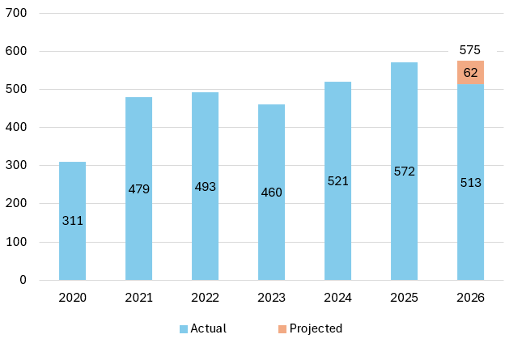
Source: Rusk O’Brien Gido + Partners, LLC transaction database; transactions with a North American buyer or seller. 2026 projected based on extrapolation of YTD activity.
While this industry is still highly fragmented, and ripe for continued consolidation, it's also an industry characterized by very low barriers to entry. When M&A activity heats up in an industry with low barriers to entry, research suggests that what often follows is a wave of new business formation.
How Mergers & Acquisitions Drive New Business Formation
This phenomenon was studied by Monia Lougui of The Ratio Institute and Anders Broström of the KTH Royal Institute of Technology in Stockholm, Sweden, and published in the Journal of Evolutionary Economics.1 The authors studied nearly 3,200 medium-sized and large firms (more than 50 employees) in Swedish labor-intensive service industries over the period from 2000 to 2009, and found that new business formation increases in the periods following a merger or acquisition, with a lag period of about two years. In one of their models, M&A activity was associated with a 16% increase in new firm formation.
They identified two primary vectors driving this activity: 1.) “Push” factors, such as lay-offs or worsening job satisfaction, that make leaving the consolidated firm less costly for employees (in our experience, often a lack of cultural or strategic alignment or the perception of diminished working conditions), and 2.) “Pull” factors: entrepreneurial opportunities created by consolidation, such as the abandonment of markets or clients viewed as less desirable or lucrative.
We’ve observed this anecdotally within the A/E industry in the U.S. through our ownership planning practice, in which we assist firms in establishing and maintaining their internal ownership structures. De novo business practices are often formed by an individual licensed engineer, architect or environmental scientist (or a small group thereof) who have left an established business following its acquisition. The two-year lag observed by Lougui and Broström also aligns with our observations. In the case of new business formations in the U.S., this lag coincides with the typical term of non-compete / non-solicitation agreements that key employees and sellers often enter into upon a merger or acquisition.
This phenomenon is not limited to professional service firms. Research on U.S. biotechnology firms points the same way: Toby Stuart of Columbia Business School and Olev Sorenson of UCLA’s Anderson School of Management found that acquisitions of nearby companies increase the founding rate of new firms in the same region, and that the effect is much stronger in states that do not enforce non-compete agreements.2
Historical New A/E Business Formation in the U.S.
Data from the U.S. Census Bureau indicates a baseline level of new business formation in the architecture, engineering and related services sector (NAICS 5413) of roughly 5,300 per year (the median) over the 20-year period from 2004 through 2023, and closer to 5,100 per year since 2010 (data for 2024 and 2025 is not yet available).
Notably, within that period, levels of new business formation peaked in 2006 at 8,115. This coincides with the peak of the housing and development boom in the U.S., and follows, by two years, a period of heightened strategic acquisitions. A headline in Engineering News-Record’s 2005 Top 500 Design Firms edition, looking back on 2004, proclaimed “Acquisitions Surge in Growing Market” and cited a wide range of transactions, both large and small, fueled by CEO confidence and what was perceived as a booming economy at the time. Examples included Worley Group Ltd’s 2004 acquisition of Parsons Engineers & Constructors and CH2M HILL’s late-2003 acquisition of Lockwood Greene.
The following chart represents U.S. Census Bureau data on new firm start-ups in the A/E industry from 2004 through 2023. It shows the peak in start-ups in the two years that followed the 2004 surge in M&A activity.
New Firm Start-ups: Architectural, Engineering & Related Services (NAICS 5413)
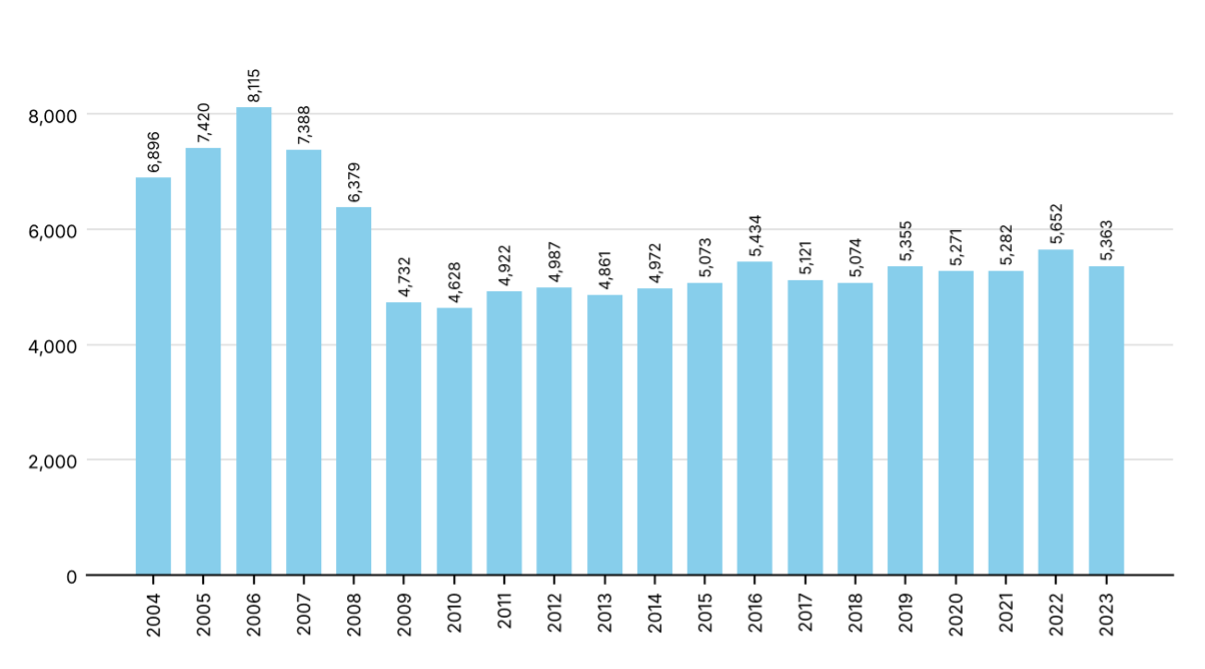
Source: U.S. Census Bureau, Business Dynamics Statistics (2023 release). Start-ups are new employer firms (firm age 0).
If history is prone to repeat itself, or at least rhyme, we should see an increase of new business formation following this current period of heightened industry consolidation. Given current demographics, this would be led by younger members of Generation X (those in their mid- to upper-40s) and perhaps some older members of Generation Y (those now in their early 40s). The question remains whether these generations have the same risk appetite, entrepreneurial tendencies, and access to capital that their predecessors had. And of course, there’s the looming specter of artificial intelligence, and whether it will create technological barriers making it hard for smaller start-ups to compete or actually level the playing field.
So, are we in for an entrepreneurial tsunami? Only time will tell, but active acquirers would be wise to consider these historical trends and focus on strategies to maximize post-acquisition employee retention, whether through economic incentives, enhancements to their workplace culture, or career development initiatives. Otherwise they may find themselves spawning a new generation of competitors.
1 Lougui, M., & Broström, A. (2021). “New firm formation in the wake of mergers and acquisitions: An exploration of push and pull factors.” Journal of Evolutionary Economics, 31(1), 65–89 (published online 17 June 2020). https://doi.org/10.1007/s00191-020-00678-4
2 Stuart, T. E., & Sorenson, O. (2003). “Liquidity events and the geographic distribution of entrepreneurial activity.” Administrative Science Quarterly, 48(2), 175–201. https://doi.org/10.2307/3556656